

Would it surprise you to learn that the online place where people talk about organizational authenticity the most is in ‘the new church movement’?
‘The new church movement’ (what I call it, but it may have other labels) is that center of online energy around being a better Christian. By better, I mean more about ending poverty, more about caring for others, more about Jesus, and also more about being ‘real’.
Now, before I go further, let me note that I write about this ‘movement’ as though (1) it is a movement, and (2) I know something more about it than your average blogospherean. I’m pretty sure it’s a movement, or at the very least a community. However, I don’t really know much about it.
Blogs from ‘the new church movement’ seem to find me, through Google. I’ve been learning about this niche almost by divine intervention accident. Nine times out of 10 a google alert on ‘authentic organization’ sends me a blog post by a pastor or congregant tying to put more meaning into each church event and each church membership.
‘The new church movement’ is a bit hip on the hipster side; it seems to be lead (online at least) by progressive, inclusive, thoughtful people who check their egos at the church door. It is not about the world of the mega-church, but about the world of the micro-church. The here and now of being an active authentic Christian.
The conversation on these blogs is a great complement to the more conventional and agnostic conversation about authentic leadership, in part because the new church movement grapples explicitly with the ways that tradition, authority and obedience make being authentic nearly impossible.
Recently I was brought to this fabulous exegesis of your basic church sign, from NakedPastor. (I did say ‘a bit hip’, didn’t I? ) NakedPastor writes a pretty rippin’ blog that has been referred to me by several different people. He kindly gave me permission to share his cartoon here.
What intrigued me about this sign (not to read it for you) is the distance between what the words say, and what they are felt (by NakedPastor and others) to mean. How can something so banal, so milquetoast-y, actually say so much? Perhaps because of the distance between the talk, and the walk?
When you read NakedPastor’s interpretation, does it make you reconsider what ‘welcome to our church’ means?
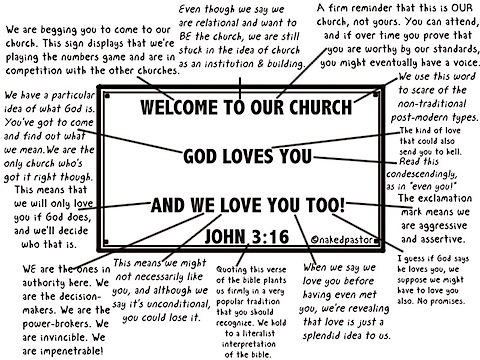
This graphic makes me wonder:
- What would an ‘authentic’ church sign be like? For any given congregation, denomination or tradition the specifics would be different, but what would be the core message? What would be the authentic description of what that congregation/organization had to offer?
- What would it be like if, at our own organizations, we put up our own ‘church sign’, a sign that enticed people to stop in and check out the view of business that we had to offer? What would we reveal about ourselves as an organization?