

There is no more incendiary question than the implicit and unspoken question that often follows the promotion of non-white and/or non-male employees:
Did s/he get the job because s/he’s qualified, or did s/he get the job because s/he’s (fill in the diversity criterion here)?
Corporate American is seldom so stupid as to promote a candidate simply & only because s/he has the right diversity characteristics. Women don’t get promoted because they are women, non-whites don’t get promoted because they are not white, and folks with disabilities don’t get promoted so that we can see a person who uses a wheelchair at a stockholders’ meeting. That’s not how it works.
But, and it’s a big ‘but’:
Organizations can and often do benefit when the demographic attributes of their employees add value to the organization’s public image.
Indra Nooyi didn’t get her job as PepsiCo’s CEO because she’s Asian Indian and a female, but it certainly helped Pepsi’s image to have a prominent executive who is female and non-white.
The demographic and physical attributes of an employee often do extra “work” for the organization that employs them, by presenting a certain desirable image that consciously and unconsciously provokes positive responses from their audience.
 BP is currently benefiting from the appointment of a Black employee, Darryl Willis, as the spokesperson for their claims efforts. Willis wasn’t chosen (or volunteered) because he’s Black– he has many other credentials that make him a great candidate for this job. But it is not insignificant that the prominent, identifiable person in BP’s television advertisements is a Black man.
Using a Black spokesperson, in a rather perverse way, helps BP take advantage of white American racism.
Having a spokesperson like Willis allows BP to take advantage of the Teddy-Bear effect — where the perceived warmth, niceness and personality of a Black man’s appearance disarms white people’s concerns and invites them to be comfortable trusting that person. Using a perceived “teddy bear” as a spokesperson may lead white Americans to trust the organization the “teddy-bear” represents.
But before we consider the Teddy-Bear Effect, check out all the other ways that BP is working to disarm us and get us to trust them, through the television and print ads that feature Darryl Willis.
Comforting, disarming visuals
In the BP Claims television and print ads, Willis’s appearance is crafted so that he appears to be more approachable. He’s wearing khakis and a polo shirt, not a suit and tie. He’s walking one-on-one with a ‘Gulf resident’, not speaking from a podium behind a name card to a large audience.
He is relaxed, direct, unhurried, and earnest.
All of the characteristics presented by Willis are intentionally crafted to make him look as friendly and trustworthy as possible.
Comforting, disarming words
The way Willis audibly delivers BP’s message is disarming. Willis has a warm, low voice and speaks with an identifiable Gulf (Southern LA) accent.
Willis’s words are also carefully crafted to make us want to like him and trust him. He’s the head of “Claims”– getting reparation money to people who’ve been hurt. He’s not an employee who helped to cause the Oil Spill; instead, he’s all about the solution. He describes himself as a ‘volunteer’. He mentions his family and Hurricane Katrina. He describes himself as “from here”.
(I don’t know whether he “volunteered” or not, but the other two description are verifiably true– his mother lost her home to Hurricane Katrina, and he has a personal anchor in the Gulf Coast, having graduated from the University of New Orleans.)
All of these features make us think:
- This spokesperson wasn’t pressured, he really cares.
- This spokesperson has a personal stake in fixing this problem.
- He’s one of ‘us’, one of the people hurt, and so he’ll treat us right.
Dis-arming the Details: What we are NOT shown
Would it surprise you to know that in addition to being the head of “Claims”, Willis is also:
- BP’s Vice President of Resources, BP America
- A scientist, specifically, a geophysicist, who is one of the 50 Most Important African-Americans in Technology
- Worked for BP most of his career, much of it on projects related to deep-water drilling in the Gulf of Mexico?
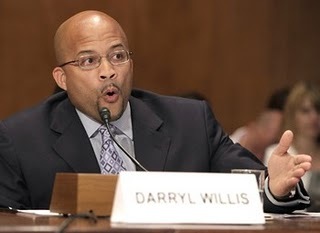 None of these details disqualifies him from the job of spokesperson or Head of Claims– but they are details that might make viewers trust him less.
— A VP? (executive compensation and access to power)
— A Scientist? (cool, rational, all about numbers not about people).
— A BP lifer? (a company man who puts the company and not us first).
So, here we’ve got an important executive, with technical credibility and scientific expertise, handling the payout of insurance claims.
And that’s even before we bring in the issue of race/racism.
TeddyBear vs. Toff
As a thought experiment , compare your impressions of Willis to your impressions of Tony Hayward in a similar kind of television ad. (You can watch this on YouTube.)
The first (Willis) is warm, friendly, approachable, trustworthy, and one of us. The second (Hayward) is cool, distant, elitist, and dismissive. One’s a Teddy-Bear and one is a Toff.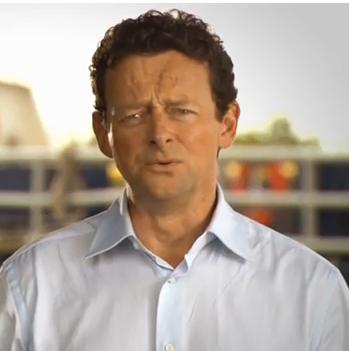
What’s a Toff? “Toff” is slang for a British person of the upper class.
What’s a “TeddyBear”? [ trigger alert] :![]()
A Teddy-Bear is a Black CEO with a “babyface”.
A babyface is characterized by combinations of attributes, including a round face, full cheeks, larger forehead, small nose, large ears and full lips. “Babyfaced adults are treated differently compared with mature-faced adults: baby-faced adults are considered more warm, innocent and trustworthy.”
Now, add race to this picture.
The “Teddy-Bear Effect” describes a racist dynamic where (some) white people (tend) to feel more comfortable with a Black man with a “disarming” appearance.
That is, they tend to feel more comfortable with Black men who, because of the overall gestalt of their facial features, appear to whites to be warmer, more friendly and open.
Black male CEOs with more babyfaced characteristics seem to non-Black observers, to be more competent and less threatening that Black men with more ‘mature” faces.
By extension,
Using a Black male spokesperson whose facial appearance may seem less-threatening to some white people might help the audience feel warmer and more trusting towards BP.
Let me reiterate that Willis is obviously quite qualified in any objective way to speak publicly on behalf of BP. He’s a VP, a geophysicist, and a long-term BP employee. He also has roots in the Gulf community. And, he comes across as warm, friendly, personable and trustworthy.
- Is it cynical to suggest that BP is benefiting from white people’s possible tendency to feel more comfortable with powerful Black men who have Teddy-Bear characteristics?
- Or to suggest that Willis’s appearance is part of an overall effort to craft BP as warmer and more caring?
What do you think?
6/31: Some additional articles on this issue:
- Bruce Ritchie, The FLorida Tribue and Environments.com: BP’s “media star” tries to reassure Florida officials
- Larry D. Woodard, ABC News/Money online: Will this man save BP’s reputation?
References:
- Robert W. Livingston & Nicholas A. Pearce (2009). The Teddy-Bear Effect: Does Having a Baby Face Benefit Black Chief Executive Officers? Psychological Science, vol. 20 no. 10 1229-1236.
- Willis has his masters degree in Geophysics from University of New Orleans, and according to their alumni newsletter was working in the Depwater Gulf of Mexico for BP as early as 2001.
See also:
From AuthenticOrganizations:BP’s Bravest Brandividual: What could be motivating Darryl Willis?
McCain Campaign Exploits the Race of Their Hired Help
From the blog: Stuff White People Do: Prefer babyfaced black men
From Black Voices: BP Chooses a Black Man to Head its Claims Process, by Boyce Watkins, PhD
Image:
Willis Testifies Before Congress, from African-American Environmentalist Association web page