

During a meeting in a downtown conference room at a non profit a few weeks ago, I noticed we were all sitting in Aeron chairs. These are geeky-stylish, ergonomically adjustable office chairs that retail for about $800 a pop. There were 12 of us in the conference room, sitting on a total of about $9,600.00, retail.
Aeron chairs are not that uncommon. I’ve been in many offices and conference rooms kitted out with Aeron chairs. But, this was the first time I’d found myself sitting in an $800 chair while having a conversation about fund-raising strategies.
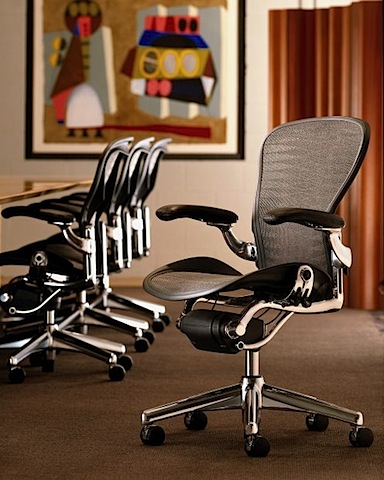
This organization’s important programs are facing budget cuts, and so they are looking for ways to ramp up their fund raising programs.
“Why bother to raise the money from individual donors?” I wondered. “We could just sell these chairs.”
And, I wondered:
Are $800 chairs a bit too rich for a nonprofit?
This particular non-profit is not the only one I’ve seen with top of the line furnishings and a relatively luxurious physical environment. While I love an aesthetically competent workspace as much as anyone, I did wonder if this particular organization had its priorities in the right places.
I silently ran through the possible explanations, which included:
- Ergonomics: The members need good chairs; they sit and work in these for hours on end.
- Sustainability: This chair is “green built“.
- Investment: A well-built chair bought once is cheaper than a poorly built chair replaced in five years.
- Impression Management: If the non-profit looks professional and ‘like a business’, people will think the organization is more competent. Their programs are media-related, and so they should look like other new media companies (all of which have Aeron chairs).
What’s wrong with $800 chairs?
What was bothering me about the chairs was that they didn’t fit with my sense of “who this organization is”. Even though I know the chairs are technically great chairs, and environmentally preferable chairs, and good-looking chairs, their premium price made me think that the organization was spending money on itself and not on serving its constituency. I was applying the “non profit stereotype” of (1) constituents first, (2) bare bones overhead, and (frankly) (3) employees come last. There are a lot of problems with this stereotype of non-profits, and there is some truth to it, too.
Given my interest in other people’s businesses, I found a way to ask about the chairs as we chatted at the end of the meeting.
As it turns out, the organization did not pay full price for the chairs. They got the chairs from new media company that was going out of business. They paid about half the retail price of the chairs. (“Oh, only $4,800? Whew.” was the expected response, I think.) So, the member explained, it wasn’t like the chairs were luxury items or something.
While this story kind of got the organization off the hook for profligate spending, the fancy chairs were still important, and still communicated something about the organization.
The chairs’ appearance in the nonprofit told a story, and the story told me about the nonprofit’ character. But, had I been less inquisitive, I’d have gone away with the completely wrong story. And that might have become a problem.
The organization displayed the chairs (and, of course, used them) but the meaning of the chairs was ambiguous. (Or polysemous, for you lit-crit folks.)
Those chairs could tell many different and equally plausible stories. They could tell:
— the “We care about our people who work here long hours” story,
— the “We’re scrappy folks, who bought these at a distress sale. We use this same scrappy attitude everywhere”, and
— the “We don’t have our priorities straight and put our own comfort before the needs of our constituents” story.
Which story is it, really?

Whichever story visitors hear, or don’t hear, makes a difference in how they perceive that organization. And, these perceptions affect how visitors feel about the organization and how they will behave towards it.
Those fancy chairs could deter someone from contributing money, or encourage someone to entrust the organization to use a grant wisely. It all depends on the story the chairs “tell”.
Of course, some folks could just have taken the chairs for granted, and not even noticed them.
Regardless, this nonprofit needs to tell a coherent story about itself, its values, its priorities and its capabilities. The organization’s environment and its furnishings don’t just sit there– they tell the organization’s story.
And this organization’s $800 chairs made me wonder what its real story is.
My Nose, Other People’s Business
Aeron Chair, a piece of art?
May 28, 2008 from Frank Rogo

