

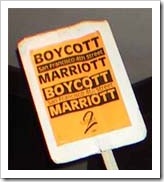
 Some supporters of GLBT rights are calling for consumers who support marriage equality to boycott "Mormon Organizations". These supporters want to punish the Mormon Church (Church of the Latter-Day Saints, or LDS) as well as Mormon individuals for supporting California’s Proposition 8 banning same-sex marriage.
(Note: The Mormon Church officially opposes same-sex marriage. However, not all active/practicing Mormon individuals oppose same-sex marriage. )
An important question for any activists intending to show their disapproval of an organization by boycotting it is finding a way to prove that the organization is culpable. One way to make an organization culpable for the perceived crimes of the Mormon Church is to identify the organization as a "Mormon Organization".
What’s A "Mormon" organization?
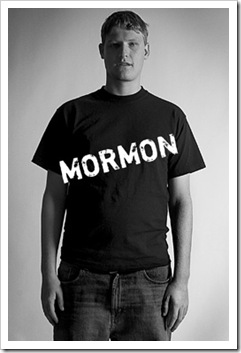 One big problem with this line of reasoning is– how do you define a Mormon Organization? What makes one organization "Mormon", and another "not Mormon"?
Looking over the array of arguments for and against boycotting the Marriott corporation, you can deduce the criteria that folks are using to determine the Mormon identity of an organization. I arrange these into 3 Tiers– Tier 1 being convincing demonstrations of being Mormon, Tier 2 being suggestive but not sufficient indicators and Tier 3 being ‘spurious indicators’.
Tier 1: Convincing demonstration of identity:
You can be confident calling an organization "Mormon" if:
- The organization is wholly or majority-owned by the Mormon Church.
- Tenets, principles and priories of the organization are based on those of the LDS Church.
- Part of the organization’s mission is furthering the causes and principles of the LDS.
- The organization looks to the Mormon Church and to Mormon Church leaders for guidance on issues related to its business.
- Practices and activities that are explicitly Mormon are official parts of the organization’s operation.
- Being a practicing Mormon is a criterion for employment or advancement in the organization.
Here’s A Clear Example of a Mormon Organization: BYU
Brigham Young University is unequivocally a Mormon organization. Note this excerpt from BYU’s mission statement :
The mission of Brigham Young University–founded, supported, and guided by The Church of Jesus Christ of Latter-day Saints–is to assist individuals in their quest for perfection and eternal life.
In addition, BYU’s mission statement document
… also draws on the religious and educational teachings of the university’s founding prophet, Brigham Young. Quotations within the text come from the scriptures and from the counsel of modern prophets, whose teachings about BYU lay the foundation of the university’s mission.
One of BYU’s explicit Institutional Objectives is to "Develop friends for the University and the Church."
All (our work is) focused on building a network of friends and supporters throughout the world who can help advance our unique mission.
Students are required to take 2 courses on LDS theology, making education in Mormon doctrine an official part of every student’s curriculum.
Being a member of the Mormon Church is not a requirement for employment or admission at BYU. However, if you are Mormon, you’re expected to be a member in good standing. Prospective students are supposed to be religiously active in some way, whether LDS or not. (98% of students are LDS.) From the Admissions web page:
Each applicant must be endorsed by his or her ecclesiastical leader as one who is worthy to attend BYU and is living in harmony with the Honor Code and the Dress and Grooming Standards.
Another Example?
Okay, maybe it’s too easy to use BYU as the example of Mormon organization. How about this organization, the More Good Foundation:
While the Foundation is fully supportive of the Church and its mission, it is not directed by or funded through the Church; no Church funds are used for the Foundation. Our funds come through the good graces of individual donors who are interested in seeing us fulfill our goals and make a positive difference with LDS information.
Tier 2: Suggestive but not sufficient indicators
A second level of criteria suggest but don’t necessarily demonstrate the identity of the organization. However, these criteria are often used by outsiders who want to assign a Mormon (or other) identity to an organization.
 Suggestive but not conclusive indicators of an organization’s identity are whether:
- The organization’s CEO is a practicing Mormon.
- The majority of the organization’s employees are practicing Mormons.
- Some percentage of the organization’s shareholders are Mormon.
- Practices and activities that are consonant with Mormon principles but are not explicitly Mormon are part of the organization’s informal culture.
- The organization contributes to the Mormon Church and/or to the Church’s initiatives through its philanthropic activity (e.g., sponsorships, CSR, pro bono work, etc.).
- Employees of the organization donate money and time to the LDS Church. (This criterion of individual donations is also used by the GoodGuide.com site
- The organization is endorsed by prominent members of the Church.
- The organization is "about the Church, but not from the Church."
to determine an organization’s political sentiments.)
On The Other Hand (OTOH): Lots of the employees of the Salt Lake City Winter Olympics were LDS members, but the SLC Winter Olympics was not Mormon.
JetBlue is run by an LDS member. That hardly makes it an LDS company.
Tier 3: Spurious ‘indicators’
Spurious indicators are criteria that plausible but false. There is just one attribute, geographic location, in this tier– but I’m sure as I keep looking at the Prop 8 boycott conversation we’ll discover some others.
OTOH: Just because the Sundance Film Festival is held in Utah does not make it a Mormon organization.
 Where is this going? ….
I’m trying to get to a complete explanation for (and especially) against boycotting the Marriott Corporation. This explanation depends on having a full understanding of the criteria that stakeholders are using to identify an organization as Mormon— whether or not their criteria is convincing or their conclusions are rational.
It’s still unclear what is necessary and sufficient for defining an authentic "Mormon Organization". It’s also interesting how the criteria that I used to define an Authentically Black organization doesn’t seem to fit the task of defining an Authentically Mormon organization.
Any criteria we should add? Anything seem off to you? Please share your thoughts…by clicking on the word "comments" {between the grey brackets, under the ShareThis icon}, below.